
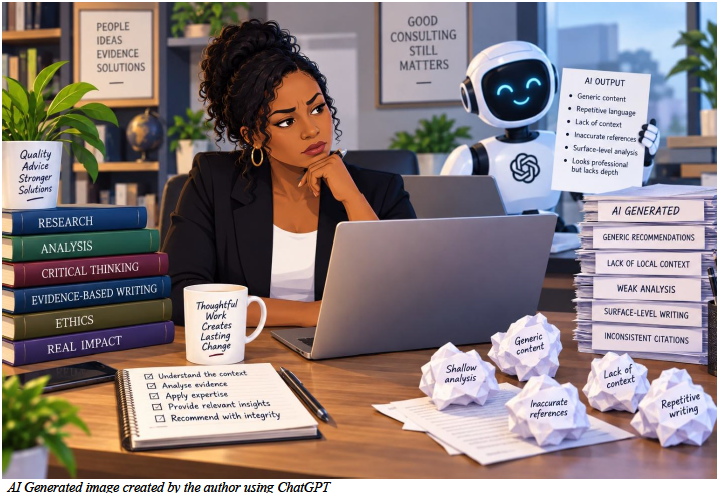
The Quiet Erosion of Consulting Quality: Artificial Intelligence and the Decline of Technical Writing Standards in Consulting Practice
Abstract
The rapid integration of generative artificial intelligence (AI) into consulting workflows has produced substantial efficiency gains alongside a measurable decline in the quality of technical reports. This article examines four observable symptoms of that decline: deteriorating grammar and sentence structure, incomplete formulation of analytical arguments, the erosion of academic and technical writing conventions, and the fabrication of references. Drawing on empirical research documenting citation fabrication rates in large language models (LLM) (Walters & Wilder, 2023), evidence of reduced cognitive engagement during AI-assisted writing (Kosmyna
et al., 2025), and the 2025 Deloitte Australia case in which a consulting firm partially refunded a government client after fabricated references were discovered in a commissioned report (Dhanji, 2025; Paoli, 2025), the article argues that responsibility rests not with the technology but with professional practice. Six recommendations are proposed for disciplined AI use: treating AI output as a first draft requiring full human review, mandatory verification of all references,retaining human ownership of analysis and interpretation, drafting high-stakes sections manually, establishing explicit firm-level AI-use policies, and protecting the analytical capabilities of
consultants themselves. The article concludes that the consulting industry’s core asset is trust, and that preserving it requires using AI as an assistant rather than a substitute for professional judgement.
Keywords: artificial intelligence, consulting, technical reports, fabricated references, quality assurance, professional integrity
The Quiet Erosion of Consulting Quality: Artificial Intelligence and the Decline of Technical Writing Standards in Consulting Practice
There is a conversation the consulting industry needs to have with itself, and it is overdue. Artificial intelligence (AI) has transformed how consultants work. In 2026, AI tools sit in meetings, take notes, draft summaries, and analyse data with remarkable speed. For
consultants juggling multiple engagements across sectors and borders, these tools are genuinely valuable, and this author uses them as well. However, something else is happening alongside the efficiency gains that the profession is not discussing enough, that is a visible decline in the quality of the technical reports the industry produces. This article describes the observable symptoms of that decline, situates them within the emerging research evidence, and proposes a practical discipline for using AI without total reliance upon it.
Observable Declines in Report Quality
Over the past year, while reviewing technical reports, situational analyses, and evaluation documents, this author has observed a troubling and recurring set of symptoms across AI assisted deliverables. Four are described below.
Deteriorating Grammar and Sentence Structure
Reports increasingly contain grammar and sentence construction that no professional would have signed off on a few years ago: sentences that run without direction, subject-verb agreements that collapse midway, and paragraphs that read fluently but fall apart under scrutiny. The polish of machine-generated prose can conceal, rather than prevent, structural weakness.
Incomplete Formulation of Thought
AI-generated text is exceptionally good at sounding finished. It produces confident topic sentences and tidy conclusions. Yet when the middle of the argument is interrogated, the analysis, the reasoning, and the implications, there is often nothing there. The argument was never actually made. This pattern is consistent with research findings that LLMs mimic the surface features of texts rather than necessarily reproducing their substantive content (Walters & Wilder, 2023).
Erosion of Academic and Technical Writing Conventions
Proper engagement with the literature, methodological transparency, and disciplined argumentation are being displaced by generic prose that could have been written about any project, in any country, for any client. In evidence-based fields such as development, policy, and evaluation, these conventions are not decorative; they are how readers assess whether a claim can be trusted.
Fabricated References
Most seriously, reports now appear with citations to journal articles that do not exist and to publications attributed to organisations that never produced them. This is not a stylistic issue but a professional integrity issue. The phenomenon is well documented: in a controlled study, 55% of the bibliographic citations generated by Generative Pre-trained Transformer (GPT) 3.5 and 18% of those generated by GPT-4 were fabricated entirely, while substantial proportions of the genuine citations contained material errors (Walters & Wilder, 2023).
The consequences are no longer hypothetical. In 2025, Deloitte Australia agreed to partially refund the Australian Government after a commissioned report valued at approximately AU$440,000 was found to contain apparent AI-generated errors, including a fabricated quotation attributed to a federal court judgment and references to non-existent academic research (Paoli, 2025). The firm subsequently disclosed that a generative AI tool chain had been used in preparing the document, and critics noted that the episode raised broader concerns about overreliance on AI and the quality control of outsourced government work (Dhanji, 2025). Decisions are made based on such documents, funding is allocated, and communities are also affected.
How the Industry Arrived Here
Responsibility for this decline does not rest with the technology. AI did not lower professional standards; practitioners did, when first drafts began to be submitted as final deliverables and reports stopped being read by their own authors before submission.
The pressures are real. Timelines are shorter, budgets are tighter, and clients increasingly expect the speed that AI makes possible. But speed was never the value proposition of consulting, it was based on judgement and context. The capacity to sit with a messy, complicated reality and produce clear, defensible analysis is what clients pay for. A tool cannot deliver that, and a consultant who outsources it entirely is no longer consulting but merely forwarding.
There is also an emerging cost to the practitioner. Research on knowledge workers suggests that generative AI use is associated with self-reported reductions in cognitive effort applied to critical thinking (Lee et al., 2025), and neurophysiological evidence indicates that writers relying on LLMs exhibit weaker brain connectivity during composition and diminished ability to recall or quote from text they have just produced (Kosmyna et al., 2025). Writing is thinking, and every report fully delegated to a machine is a set of analytical muscles left unexercised.
Using AI Without Total Reliance
The solution is not abandonment of these tools, which would be both unrealistic and unwise. What is proposed instead is a discipline for their use, comprising six practices.
Treat AI Output as a First Draft, never a Deliverable
No firm would send a junior associate’s untouched first draft to a client. The same standard applies here. Every AI-assisted document should pass through genuine human review: read in full, checked for logic, and interrogated for whether the argument holds true.
Verify Every Reference Without Exception
If the consultant did not open the source and read it, it does not belong in the report. Reference verification should be a mandatory step in quality assurance processes, in the same way that financial audits verify transactions. A citation that cannot be traced must be removed.
Keep the Analysis Human
AI should be used for what it does well: transcription, meeting notes, first-pass summaries, reformatting, and identifying patterns in large datasets. The interpretation of what the findings mean, what the client should do, what the risks are must come from the consultant. That is the layer where expertise, contextual knowledge, and accountability reside.
Draft High-Stakes Sections Manually
Executive summaries, recommendations, and conclusions are where consulting value is concentrated. These should be drafted by the consultant, with AI used afterwards to refine language if needed, and not the other way around.
Disclose Use and Set Standards Within Firms
Consulting firms should adopt explicit AI-use policies covering which tools may be used, at what stages, with what review requirements, and how client confidentiality is protected when documents and meeting recordings are submitted to third-party platforms. Disclosure to clients should be the norm rather than an admission extracted after errors surface, as occurred in the
Deloitte case (Paoli, 2025). Silence on this question is no longer acceptable.
Protect Professional Capability
The consultants who will remain valuable in five years are those who use AI to extend their thinking rather than replace it. Given the evidence that habitual delegation of writing is associated with reduced cognitive engagement (Kosmyna et al., 2025; Lee et al., 2025),
maintaining regular unassisted analytical writing is not nostalgia; it is professional maintenance.
Conclusion
The consulting industry runs on trust. When a client commissions a technical report, they trust that a qualified professional stands behind every claim, figure, and all the references within it. Each fabricated citation and each unedited document chips away at that trust, not only for the individual consultant but for the profession. Artificial intelligence is the most powerful assistant the profession has ever had. It should be used as an assistant, while consultants remain, unmistakably, the professionals in the room.
References
Dhanji, K. (2025, October 6). Deloitte to pay money back to Albanese government after using AI in $440,000 report. The Guardian. https://www.theguardian.com/australia-news/2025/oct/06/deloitte-to-pay-money-back-to-albanese-government-after-using-ai-in-440000-report
Kosmyna, N., Hauptmann, E., Yuan, Y. T., Situ, J., Liao, X.-H., Beresnitzky, A. V., Braunstein, I., & Maes, P. (2025). Your brain on ChatGPT: Accumulation of cognitive debt when using an AI assistant for essay writing task. arXiv. https://arxiv.org/pdf/2506.08872
Lee, H.-P., Sarkar, A., Tankelevitch, L., Drosos, I., Rintel, S., Banks, R., & Wilson, N. (2025). The impact of generative AI on critical thinking: Self-reported reductions in cognitive effort and confidence effects from a survey of knowledge workers. In Proceedings of the 2025 CHI Conference on Human Factors in Computing Systems (pp. 1–22). Association for Computing Machinery. https://dl.acm.org/doi/epdf/10.1145/3706598.3713778
Paoli, N. (2025, October 7). Deloitte was caught using AI in $290,000 report to help the Australian government crackdown on welfare after a researcher flagged hallucinations. Fortune. https://fortune.com/2025/10/07/deloitte-ai-australia-government-report-hallucinations-technology-290000-refund
Walters, W. H., & Wilder, E. I. (2023). Fabrication and errors in the bibliographic citations generated by ChatGPT. Scientific Reports, 13, Article 14045. https://doi.org/10.1038/s41598-023-41032-5